Posts

A Train of Riots

Image
Interesting fact : After the 2002 Gujarat riots, countries like the US and the UK banned the chief minister Narendra Modi from entering these nations for his condemnable and irresponsible handling of the riots. This ban wasn't revoked until he was nominated as a candidate for the Prime Minister of India.  Hindu-Muslim violence has persisted in India for long; every time status quo ante bellum seems to re-establish itself, a new case of an egregious pogrom emerges and haunts the whole nation, for a brief span. It is widely seen, that the brunt of the violence and assault is faced by the minorities and a political hand is always involved in such an orchestration of organized crime.  Back in 2002, when Narendra Modi was the chief minister of Gujarat, a spiteful rumour spread like a wildfire and brought fresh riots to the Muslim town of Godhra. As a train of Hindu pilgrims was halted at the Godhra station, the Hindus coerced the Muslims to chant hindu mantras. Later, the engine of...

The Demolition of Secularism in India

Image
The Demolition of the Babri Masjid and its Aftermath As old as the Mughal Empire, the Babri Masjid was a venerated place of worship for the Muslims. The first Mughal emperor, Babur looked after its construction and hence the temple got its name. Situated in the holy town of Ayodhya in Uttar Pradesh, it had endured centuries of rain and rifts to stand strong for the worshippers. But on 6 December 1992 when some notorious Hindus climbed the mosque's domes, it was a matter of hours until the domes would fall and with it bring along the fall of secularism in India.  Sacred Hindu texts assert that God Ram was born in the city of Ayodhya and the site of the mosque was the actual site of His birth. Though there is no evidence to prove these claims (as Ram is a mythological figure, not a historical one), it is further disputed that Babur destroyed a Hindu temple at that site and built a mosque. In 1948, as the desire for a Ram temple at his birthplace started becoming more prevalent and a ...

The Fall of a Big Tree

Image
The Anti-Sikh Riots of 1984 The story began in 1972 when the Congress Party won the Punjab assembly elections and the Shiromani Akali Dal (SAD) was defeated. The Congress was in power at the center, as well, with Indira Gandhi leading the government. The SAD had put forward some political demands in the Anandpur Sahib Resolution which sought to make Punjab more autonomous and only leave matters like defense with the center. Punjab had lost 2 of the 5 rivers it is named after to the Partition and had to share the rest 3 with Haryana and Rajasthan; Punjab wanted a bigger share of the water. Moreover, they demanded the city of Chandigarh be returned which was being shared with Haryana.  Congress dismissed these demands citing that other states need to give permission to them, too. Twice had the Indira government made a decision but those were not accepted by the SAD. To make a singlehanded decision again which would not resolve the issue would simply have been unwise. Meanwhile, in Pu...

The Ruthless Pacifier

Image
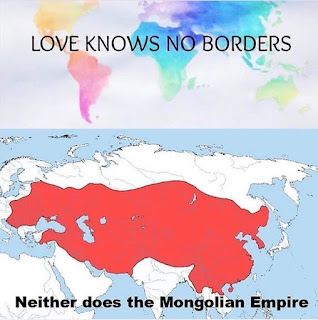
Mongol leader Genghis Khan (1162-1227) rose from the ashes of the previous generation to establish the largest interconnected empire in history. After uniting the nomadic tribes of the Mongolian plateau, he was the only one able to successfully conquer major chunks of central Asia and China. His descendants further expanded the empire, advancing to far-off places as Poland, Vietnam, Syria, and Korea. At the peak of their legacy, the Mongols were able to easily control 12 million contiguous square miles, an area around the size of Africa. He was able to grant religious freedom to his subjects, abolish torture, encourage imports and exports, and also created the first international postal system. Genghis Khan made the impossible possible by conquering more than twice as much land as any other person in history, bringing Eastern and Western civilizations into contact in the process. Did you know?  Mongol leader Genghis Khan never allowed anyone to paint his portrait, sculpt his image,...

Winter is coming.

Image
Arguably, one of the best shows to be ever made, Game of Thrones followed the stories of various rulers vying for power over the fictional continent of Westeros. The complex world of GOT was first discovered by our world in the series of novels named A Song of Ice and Fire, written by George R. R. Martin. The show reached every pinnacle of success and fame but very few people know about the fact that GRRM's exquisite world is based on the War of the Roses, a series of civil wars fought for the throne of England.  Fought in the 15th century, the conflict was initiated by the death of the ruler King Edward III and the instant succession of his grandson, Richard II, as the ruler. Edward's eldest son had already died before the death of his father. Passing of the throne directly to the grandson enraged the four other sons of Edward. This complex kerfuffle of inheritance guaranteed a tussle within the family and various generations began claiming the right to the throne. Richard was...

Regal affairs continued

Image
At last, the tenth year is finally here. The 'Iliad'  narrates the events of this year only over a period of fifty-one days. Throughout the war, the Greeks have laid claim to many war prizes from the surrounding countryside. One of these prizes just so happens to be Chryseis, the daughter of Chryses, a priest of Apollo. A quarrel takes place between Achilles and King Agamemnon. Achilles claims that her release would palliate the Wrath of Apollo upon the entirety of the Greek army. The dubious king refused to heed to Achilles, this ultimately leads to Achille's withdrawal from the war. At this point, Achilles' companion Patroclus borrows his armor and enter the battle with their contingent of soldiers to help the distressed Greeks who have been fighting for weeks till no end. Supposing it to be Achilles himself, the Trojans flee in terror from the camp before Patroclus, who pursues them to the town and lays waste to everything they held dear. At last Patroclus, himself i...

Regal Affairs

Image
                             The Judgement of Paris and The Trojan War Greek poet Homer eloquently wrote about the events of the Trojan War in his epics Iliad and Odyssey . Though the Iliad focuses primarily on the end stages of the War, it was actually a 10-year siege by the Greek army on the land of Troy - to which Homer constantly alludes. But The Iliad can prove to be a tedious read (it goes on for 15,693 lines) and movies based on it like the Brad Pitt starrer Troy (2004) aren't always credible sources of knowledge as they are rife with factual inaccuracies. Let's find out here what actually led to the war and what were the significant events that took place during the war.  Paris, the son of Troy's ruler, Priam, was at a banquet hosted by the Greek God Zeus to celebrate the birth of Achilles, wherein he was deemed worthy and befitting by the mighty Zeus to judge who is "the fairest". To this feast, Er...